
Learn with Chord Compass
How to Play Piano by Ear: 5 Clear Steps
Learn how to play piano by ear with clear steps for finding the key, bass, melody and chords, then checking your notes against a recording at your own pace.
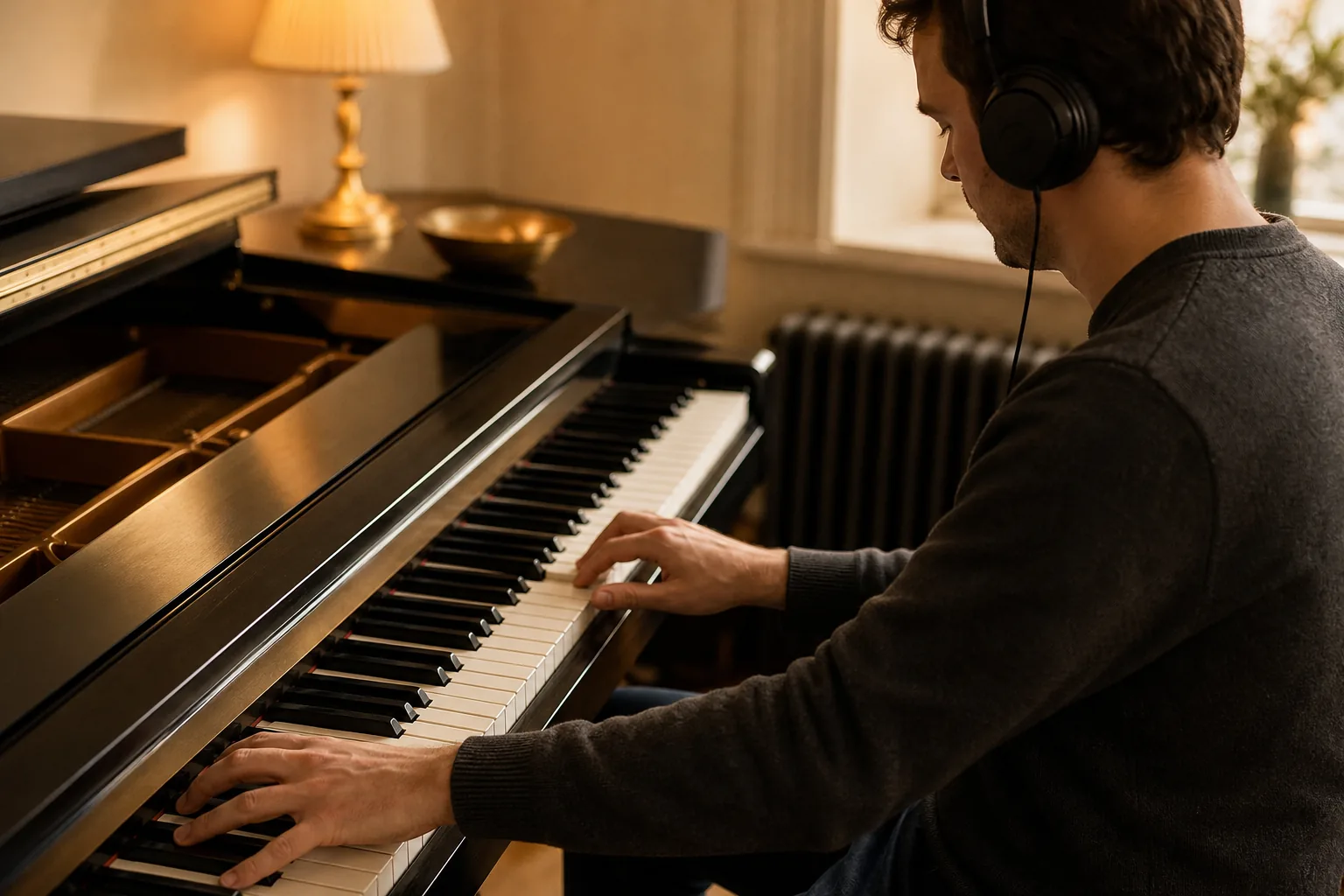
Want to hear a song and find your way to it on the piano? Learning how to play piano by ear starts with small clues, not perfect pitch. We’ll work from the song’s home note to its bass, melody and chords, then put those parts together at a pace that feels manageable.
Step 1: Listen for the song’s tonal centre
Choose a song you know well, with a clear sense of key. Keep it simple at first: a steady tempo, a clear melody and a part you can hum are good signs. A solo voice or piano line is easier to follow than a dense mix with several layers. Listen once without playing. Notice where the music feels settled, as if it has come home.
That resting point is the tonal centre, often called the tonic. A phrase ending can offer a clue, but neither its final note nor the first chord necessarily identifies the tonic. Hum the resting note, then search for it on the keyboard. Try one key at a time, and listen for the point where the note sits comfortably under the song.
When a note clashes, move up or down by one key. When it fits, test the note against a phrase ending. You’re listening for a sense of rest, not merely a note that sounds pleasant. Then play a major triad on that note. Try its minor version too. Compare the actual pitches, particularly the third above your proposed tonic. A major or minor third is more useful evidence than whether the song feels happy or sad.
You don’t need absolute pitch, the ability to name a note without a reference. Relative pitch means hearing how one note relates to another, and you can build it by listening and checking. Berklee Online’s ear-training exercises explain how singing and listening connect notes to their function within a key. For a simple exercise, play middle C, then another note. Sing the distance between them before you name it.
Keep a note of your best guess. You can change it later when the bass or melody gives you more evidence. A first guess is a starting point, not a verdict.
Step 2: Find the bass notes and chord roots
Now listen for the lowest clear note in the song. The bass often points towards the chord’s root, so it can help you trace the harmony before you tackle the tune. Hum that low note, then find it on the piano. Work through one chord change at a time instead of trying to catch the whole song in one pass.
Loop a short section if you can. Listen for the moment the bass shifts, and mark the note you hear. If you’re using a recording player, repeat the same few seconds. A brief pause between listens can help you hold the sound in your mind before you search the keys.
The lowest note isn’t always the root. A chord can be inverted, which means one of its other notes sits in the bass. A passing bass note may also fall between chord tones. Treat the bass as a clue, then test possible chords above it. Start with the three-note chords built from the likely key. In C major, for example, the diatonic triads are C major, D minor, E minor, F major, G major, A minor and B diminished.
Try each possible chord against the recording. Listen for how its colour fits, and whether its notes support the melody. If two chords seem close, compare them one after the other while the same part of the recording plays. Turn off sustain while you test. It can blur one chord into the next and make a passing sound seem like part of the harmony.
For more help hearing chord shapes at the keyboard, this piano chord lesson gives you another place to build those skills. Chord Compass Academy also teaches harmony from first principles, so you can connect a sound you hear with a shape you can play.
By now, you should have a rough map of the bass changes, plus a few chord candidates. It doesn’t need to be perfect yet.
Step 3: Work out the melody in short phrases
Start with a line you can sing. A chorus or a short phrase from a verse is enough. Listen to it once, pause the recording, and hum the phrase back. Then find the first note on the piano. If you can sing the tune, you already have a sound to compare with each key you try.
Keep the phrase short, perhaps three or four notes to begin with. Find the first note, then ask whether the next note rises, falls or repeats. Search for that movement on the keyboard. Once you’ve found the next note, sing the phrase again and check that its shape still feels right. Work forward in small groups rather than guessing at a whole line.
Your key gives you a useful set of notes to try first, but melodies can also include chromatic notes outside that scale. If you think the song is in C major, begin with the notes of the C major scale. Many melody notes also belong to the chord underneath them. Try those chord tones before reaching for every key. If a stepwise note between two chord tones sounds right, it may be a passing note.
Rhythm matters as much as pitch. Tap the pulse while you listen. Notice which notes last longer and where the phrase breathes. If the notes are right but the tune still feels wrong, slow down and check the rhythm before changing pitches. You can sing the rhythm on one repeated note first, then add the melody back in.
For a layered recording, follow one clear part. If you slow the passage down, use a setting that preserves pitch, so you are still matching the original notes. With a recording you are permitted to edit, the vocal-isolation walkthrough from Indepth Jay Beats offers an optional way to hear a vocal line separately. Separation can introduce artefacts, so compare it with the original rather than treating the isolated track as exact.
Chord Compass Academy’s guide to the best books for learning music theory can help you choose a way to study the ideas behind scales and intervals. Meanwhile, you can train your ear without naming every note. Sing a short phrase, find it on the keys, then start on another note while preserving each interval in semitones. This may require different black keys and fingering; simply shifting the same hand shape is not enough.
By the end of this step, you should have one short melody phrase you can hum and play back. Leave the next phrase for another round.
Step 4: Combine the melody with a simple accompaniment
Put the melody in your right hand and begin with one bass note in your left. Play them together slowly. If the sound fits, add the rest of the chord. This order helps you hear how the melody sits over the harmony, instead of asking both hands to solve several puzzles at once.
For a steady first accompaniment, play the chord once at the start of a bar. If that feels comfortable, repeat it with the pulse. You could also try a root-and-fifth pattern: play the chord root, then the fifth above it. In C, that means C followed by G. Keep the left hand soft enough that the tune stays clear.
Let the song’s rhythm guide your touch. A slow ballad may leave space between chords, while a brisk song may call for a lighter, more regular pulse. You don’t need to copy every sound in the recording. First make a version that keeps the tune recognisable and the changes in the right places.
If the melody and chords fight each other, check the chord change beneath the note that sounds wrong. It may be the wrong chord, or the melody note may sit outside the chord while still belonging to the key. Check the heard melody against the recording before altering it. A correct non-chord melody note does not need replacing merely to fit your guessed accompaniment.
Once the basic version feels steady, make one small change. Try a different rhythm in the left hand, or answer the melody with a short phrase of your own. You can also use a backing track or the original recording at a low volume. If you lose the pulse, stop and return to the bass notes before adding more movement.
Play the same section twice. On the second pass, change one detail, such as the chord rhythm or the final note. That small experiment builds a bridge from copying a song to making it yours.

Step 5: Check your notes and practise deliberately
Record a short section of your playing, then listen back beside the original. Check one thing at a time. Does the melody rise and fall in the same way? Does the bass change at the same moment? Does the rhythm feel close? If you try to judge every detail at once, it’s harder to hear what needs work.
When something sounds off, return to the smallest part you can repeat. If one melody note is uncertain, play the note before it and the note after it. Compare the little group with the recording. If a chord feels wrong, strip it back to the bass and one upper note. Add notes again only when the sound settles.
Between song sessions, try a short listening task: play two notes, sing them back, and identify whether the second rises, falls or repeats. Then test that same relationship in your song. A drill is useful when it connects to playing.
Keep your practice plan light enough to repeat. For example:
- Listen and hum one phrase.
- Find its notes or bass movement.
- Play the phrase with a simple accompaniment.
- Record one pass and choose a single point to improve.
Short, focused sessions can fit around other practice. You might spend a few minutes matching notes, then work on one song phrase. If you have more time, revisit the same passage in another key. Moving it to a new key helps you hear the intervals as relationships rather than fixed finger patterns.
There’s no need to ban sheet music or theory. Reading can help you check a rhythm or name a note, while your ear remains the guide for matching the recording. Chord Compass Academy’s books cover piano foundations, music theory and reading music as separate areas of study. Choose the one that fits the question you’re working on.
By now, you should have a repeatable routine: listen, make a guess, test it at the keyboard and correct one detail. Keep a short note after each session, such as “melody found; second bass change needs checking”. Next time, you’ll know where to begin.
Frequently asked questions
Can you learn to play piano by ear without perfect pitch?
Yes, you can learn to play by ear without perfect pitch. Start with relative pitch: compare notes with a reference, then listen for how each note moves. Humming a familiar melody and finding it on the keyboard gives your ear and hands a clear task. Accuracy grows through repeated listening and checking.
What’s the easiest song to learn by ear?
The easiest song is one you know well, with a clear tune and a steady pace. Pick a song you can hum without the recording. A simple melody is easier to hold in your mind than a dense arrangement, and you can begin with only a few notes before working on its bass or chords.
Should I find the melody or chords first?
Begin with whichever part you can hear most clearly. Many learners find it helpful to locate the tonal centre, then trace the bass and chord roots before adding a melody phrase. If the tune is much clearer than the bass, start with the tune instead. Keep each task short and use the recording to check your guess.
How can I practise playing piano by ear each day?
Set aside a short, focused session for one listening skill and one song phrase. Hum the phrase, find its notes, then test the bass or chord beneath it. Record a pass and listen for one point to improve. A repeatable routine matters more than trying to work out an entire song at once.
Choose your next step
Try the piano-book preview
For a structured piano foundation alongside your listening practice, explore Root Position, Edition 2 from Chord Compass Academy. Try the two-chapter preview on the product page before choosing the PDF.