
Learn with Chord Compass
How to Use a Metronome for Piano Practice
Learn how to use a metronome to find a steady tempo, count beats, practise tricky rhythms and build speed with calm, clear steps for piano practice.
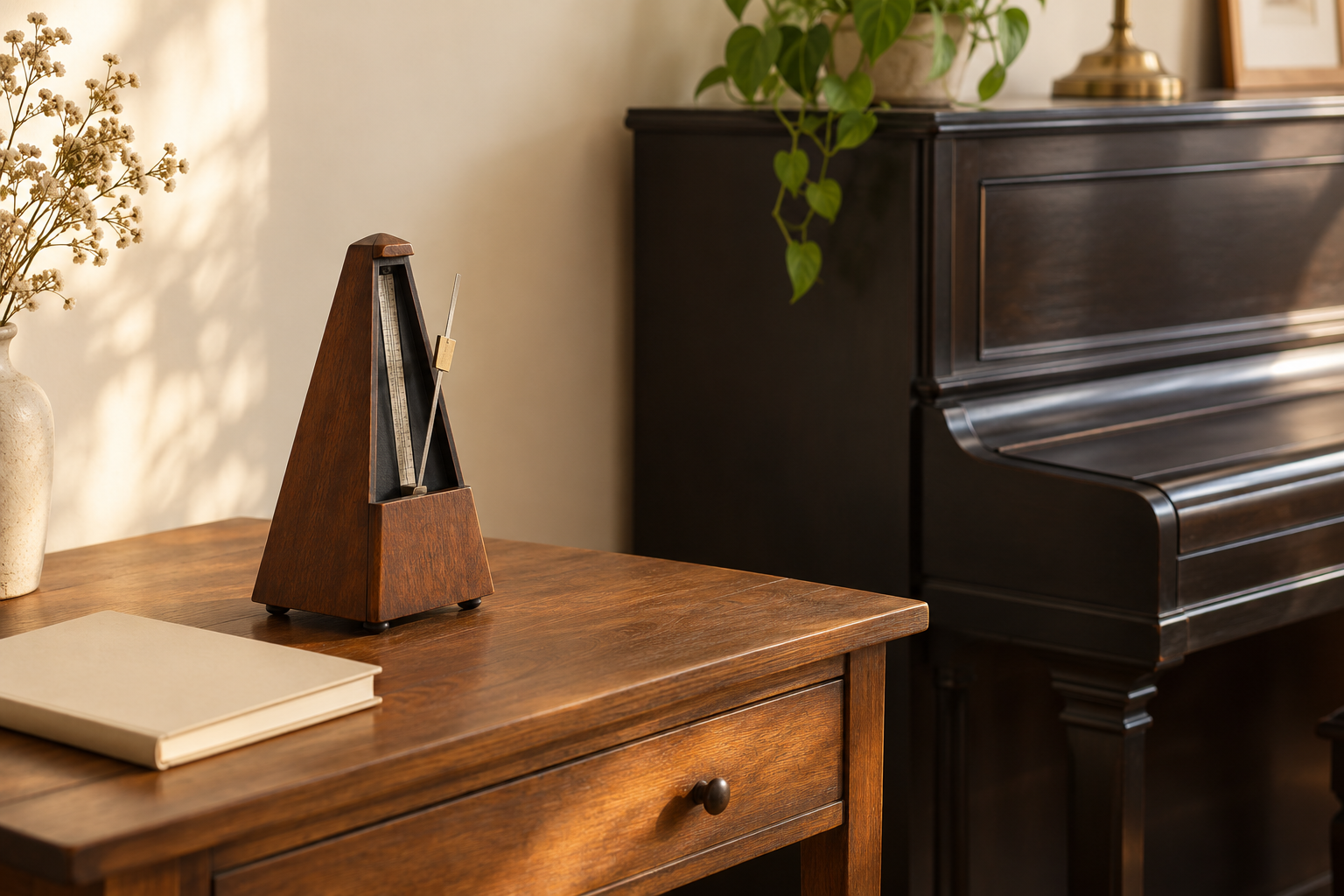
To use a metronome, choose what each click represents, set a comfortable tempo, listen and count, then play a short passage with the pulse. Start with a simple rhythm and adjust the speed when you can repeat it comfortably.
Step 1: Choose a Tempo You Can Play Comfortably
Find a starting speed where you can play the notes and rhythm accurately without strain.
A metronome provides a regular pulse measured in beats per minute, or BPM. With one click per beat and subdivisions switched off, 60 BPM gives one click each second. This reference helps you notice when an easy bar speeds up or a difficult one slows down.
On a digital metronome or app, select the BPM using its controls, choose the number of beats in a bar if available, and press start. Keep subdivisions off for your first attempt. Controls vary: Korg describes numeric and tap-tempo settings for its MA-2, for example. Set the volume so you can hear both your playing and the click.
First, look at the music for a tempo marking, including the note value beside any BPM number. A crotchet = 60 marking means 60 crotchet beats per minute. If there isn't one, choose a slow starting point. For a new passage, 50 to 60 BPM can be a useful place to try. It's only a starting range, not a rule. Choose a speed that leaves you time to listen, count and move comfortably; it need not be your fastest accurate speed.
Pick a short section, perhaps one bar or two. Set the click, listen for a few beats, then play once. If your fingers stumble, you hold your breath, or you lose track of the count, turn the tempo down. A passage that feels easy enough gives your hands room to learn the pattern.
For piano learners, a focused routine makes it easier to return to the same passage without starting from scratch. These steps for focused piano practice can help you make slow passage work part of a manageable session.
Chord Compass Academy offers Root Position, Edition 2, a piano foundation PDF with a 12-week practice plan. Preview two chapters to see whether its approach suits you.
Step 2: Set the Beat and Count Along
Know where each beat sits before you add the notes.
Set the metronome to match the beat in your music, then listen before you play. If the piece is in 4/4, count four beats in each bar: "1, 2, 3, 4". In 3/4, count "1, 2, 3". The time signature tells you how beats are grouped in a bar. Our guide to counting music beats connects these groups with notes, rests and subdivisions.
For a first attempt in 4/4 or 3/4, let each click mark a crotchet beat. If your metronome has an accent, let the stronger sound mark beat one. That small cue can help you feel where a new bar begins. For a waltz in 3/4, hear the shape as strong, light, light. For 4/4, keep the count moving evenly rather than leaning on beat one too much.
Count aloud while you listen. Then tap your hand or foot gently with each click. When that feels steady, speak the count while tapping. It may feel like a lot at first. Give yourself time to hear the beat and move with it before asking your fingers to do more.
When counting alone feels comfortable, play one note on each beat. Keep the sound even. If you're reading a new score, you can also use this pulse-first approach with a short piano sheet-music reading routine, starting at a speed that lets you count each bar.
By now, you should be able to hear the beat and say the count without chasing the click. Next, add a small piece of music.
Step 3: Play a Short Passage in Time with the Click
Match a short, familiar section to the beat while keeping your body relaxed.
Choose one phrase or a small group of bars. Don't start with the whole page. Set the tempo you found in Step 1, listen through a bar, then begin on the next beat one. If the phrase begins with a pickup, count a full bar first and enter on its written pickup beat. Keep counting as you play, even if you know the notes well. Familiarity can make it tempting to rush through the easy part.
Use a simple loop. Play the passage once, pause briefly, then repeat it. Try three steady repetitions at the same tempo as a starting checkpoint; use more time if needed. If the timing slips on the second or third try, stay at the same speed or slow down. The aim is to make each repetition steady, not to get through the passage quickly.
Listen for where notes written on a beat land. Are they together with the click, slightly before it, or a little after it? Notes between beats should follow their written rhythm. Don't tense up to force an exact match. Keep your hands loose and notice the pattern. If one transition keeps catching you out, begin a little before that spot and include the change in your short loop.
Try this with a scale, a chord change or the first few bars of a piece. For example, if a left-hand chord change makes you hesitate, practise only the bar that contains it. Count the beat before the change, then place the new chord on its written beat. Once that small section sits comfortably, join it to the bar before and after.
If the click starts to feel like a judge, take a breath and reset. It's there to steady the pulse, not to grade your playing. You can stop the click between attempts, listen to the phrase in your head, and start again when you're ready.
Keep counting through rests and held notes. A rest has a measured duration, so avoid shortening it to reach the next note. Check note releases as well as attacks.
Step 4: Practise Subdivisions and Tricky Rhythms Slowly
Hear the smaller note values that fit between the main beats.
A click on each beat gives you the main pulse, but many notes fall between those clicks. These smaller divisions are called subdivisions. For two even notes per beat, count "1-and, 2-and". For four notes per beat, count "1-e-and-a". Say the words at an easy speed first, then play the notes in the same spaces.
In 4/4 with crotchet = 60, two straight quavers occupy each click interval: play the first on the click and the second halfway to the next. Four semiquavers divide that interval into four equal parts, beginning on the click. Listen for equal spacing. If the notes bunch up, reduce the tempo or simplify the passage.
If the gaps between clicks feel too wide in a slow piece, double the metronome speed and treat the extra clicks as checkpoints. For instance, if you're practising at a pulse of 40 BPM, you could try 80 BPM and count two clicks for each original beat. This can make it easier to hold a long note without drifting.
For a quick note pattern, try setting the click to every beat first. Once the rhythm feels steady, halve the click rate and let clicks mark beats one and three in 4/4. For crotchet = 60, set 30 clicks per minute while keeping the crotchet pulse at 60. You'll need to carry the pulse through the quiet spaces yourself. Return to every beat if your timing wanders.

In 6/8, there are normally two dotted-crotchet beats per bar, each divided into three quavers. The Open University explanation of compound time shows this grouping. At dotted crotchet = 60, use two clicks per bar and count "1-la-li, 2-la-li", with 1 and 2 on the clicks.
Chord Compass Academy's Reading Music, Decoded is designed for learners building notation and rhythm-reading skills. If written rhythms are the part that needs more attention, a clear counting routine can sit alongside your metronome work.
Step 5: Increase the Tempo Gradually and Check Your Playing
Add speed in small steps while keeping the rhythm and notes under control.
After several steady repetitions, try a small increase, such as 2 to 5 BPM. Repeat at the new setting and listen. The size of the change depends on the passage and your current control; there is no required jump or timetable.
Keep a brief note of your starting tempo and the fastest tempo that still feels clean. For example: "Bar 5, 55 BPM, three steady runs." This makes it easier to pick up next time. It also stops you from guessing whether yesterday's faster attempt was controlled.
Check both accuracy and ease. Did you play the right notes? Did the rhythm stay even? Could your shoulders and hands stay relaxed? If one answer is no, return to the last speed that felt secure. Speed gained by forcing the passage tends to fall apart when you join it to the rest of the piece.
When the metronome feels too demanding, lower the setting until you can follow it without rushing or dragging. A slower click isn't a setback. It gives you space to notice what needs work, then build the passage again one small step at a time.
Once a section feels secure at its target speed, try playing it without the click. Keep counting inside, then turn the metronome back on and compare. You can also mute it for a bar and listen for whether you return in time when the sound comes back. The click is a useful guide, but your own sense of pulse is the skill you're practising.
Use the same approach for a scale or a chord pattern. Raise the speed only after the current tempo feels settled. If the sound turns stiff, take the click away for a moment and shape the phrase freely, then bring it back to check the pulse.
By now, you should have a repeatable loop: find a clean tempo, play three steady times, then increase in a small step. Stop raising the speed as soon as accuracy slips.
Frequently Asked Questions
What tempo should I set my metronome to?
Set it to a speed where you can play the passage accurately and without strain. For new material, you might test a starting point around 50 to 60 BPM, then adjust to suit the rhythm. If you stumble or lose the count, slow it down. Choose a comfortable speed that leaves attention for sound and movement as well as accuracy.
How long should I practise with a metronome?
Practise for as long as you can listen closely and stay relaxed. A short session on one bar can be more useful than repeating a whole piece while your attention drifts. Take a pause if the click starts to frustrate you, then return with one clear aim, such as even quavers.
Should I use a metronome for every song?
No. Use it when you want to check a steady pulse, even out a passage or learn a rhythm. Once the timing feels secure, try playing without it so you can shape the phrase and listen to the music as a whole. Bring the click back when you want to check the pulse again.
Why can't I stay in time with a metronome?
The tempo may be too fast, or you may be trying to play before you've heard the beat clearly. Stop, listen to a few clicks, then count aloud and tap along. Add the notes only when the pulse feels steady. For dense rhythms, count the smaller subdivisions between clicks.
Build a repeatable metronome routine
Choose one passage for today
Keep the routine small: choose a comfortable speed, count the beat, then repeat a short passage until it feels steady. Raise the tempo in small steps only after clean repetitions. For a written piano practice resource, explore Root Position, Edition 2 from Chord Compass Academy, then try the routine with one passage today.