
Learn with Chord Compass
Best Music Theory Workbooks for Every Learner
Compare five music theory workbook options for different learners, from guided piano study to harmony practice. Find a format that fits your goals.

A good music theory workbook helps you connect what you see on the page with what you hear and play. Chord Compass Academy offers a downloadable theory PDF; the other picks suit different study styles, including exam practice and focused harmony work.
This comparison uses publishers’ descriptions and sample information to distinguish the options. It is not based on hands-on testing. Start by deciding whether you need explanations, written drills or a particular grade level. A book can be useful without covering every possible topic.
1. Chord Compass Academy
Chord Compass Academy’s Music Theory, Decoded, Edition 2 is a 150-page PDF for self-directed learners who want to understand how notes, scales, intervals, chords and harmony fit together. It suits piano learners, returning players and musicians who want to make sense of the sounds they already know.

The book offers explanations, usable examples, hands-on exercises and written checks with answers. It is a downloadable PDF. The product page separately offers a free two-chapter preview with audio exercises. Use that preview to check the level and teaching style before choosing the book.
If you’re unsure where to begin, start with one small idea, such as how a scale relates to a chord you already play. Then try the same idea in a short passage. A steady routine matters more than racing through pages. Our step-by-step plan for learning music theory gives you a simple order for building those ideas.
It may suit you if you want a downloadable explanation of theory alongside your own playing and written practice. You can explore the book’s contents and two-chapter preview on the live product page, linked at the end of this article.
2. Music Theory Workbook for All Musicians by Hal Leonard
Music Theory Workbook for All Musicians, by Chris Bowman and published by Hal Leonard, is a self-study book for musicians who want written practice across a broad set of theory topics. It’s suited to learners who are happy to work through explanations and examples, then write in answers and check their understanding.
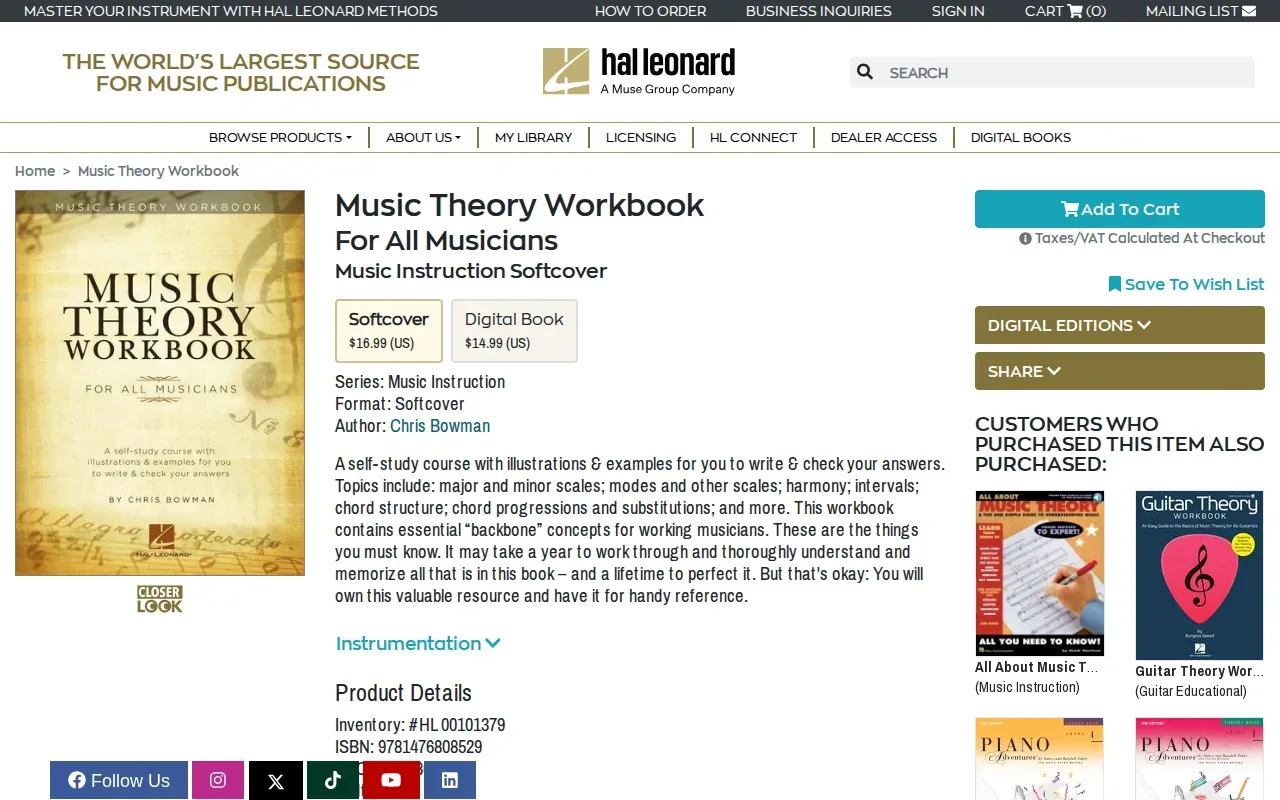
The listed topics include major and minor scales, modes, intervals, chord structure, harmony, progressions and substitutions. Illustrations and examples accompany the exercises. That range can help you move between a single note pattern and the larger question of why one chord leads naturally to another.
For example, after studying a major scale, you might use the exercises to think about the chords built from its notes. Then listen to a progression you know and notice how its harmony moves. The book is pitched as a substantial self-study course, so it may suit learners who want a reference they can return to as their knowledge grows.
It’s a general theory resource rather than a piano-only title. It is offered as a softcover or a cloud-based digital book, so check whether you need offline access before selecting a format. For a useful independent example of the underlying theory, the Open Music Theory explanation of triads shows how three-note chords are built.
Choose this one if you want broad written drills and a self-study structure. Its focus is on theory practice rather than a particular instrument. If written sharps and flats are a sticking point, our explanation of key signatures provides a focused starting exercise.
3. Music Theory Beginner A
Music Theory Beginner A, by Glory St. Germain and Shelagh McKibbon-U’Ren, is the opening workbook in Ultimate Music Theory’s ABC series. Its publisher presents it for young beginners. Topics include keyboard groups, steps and skips, early staff reading and basic note values. Adult beginners can inspect the sample level and presentation before deciding whether it suits them.
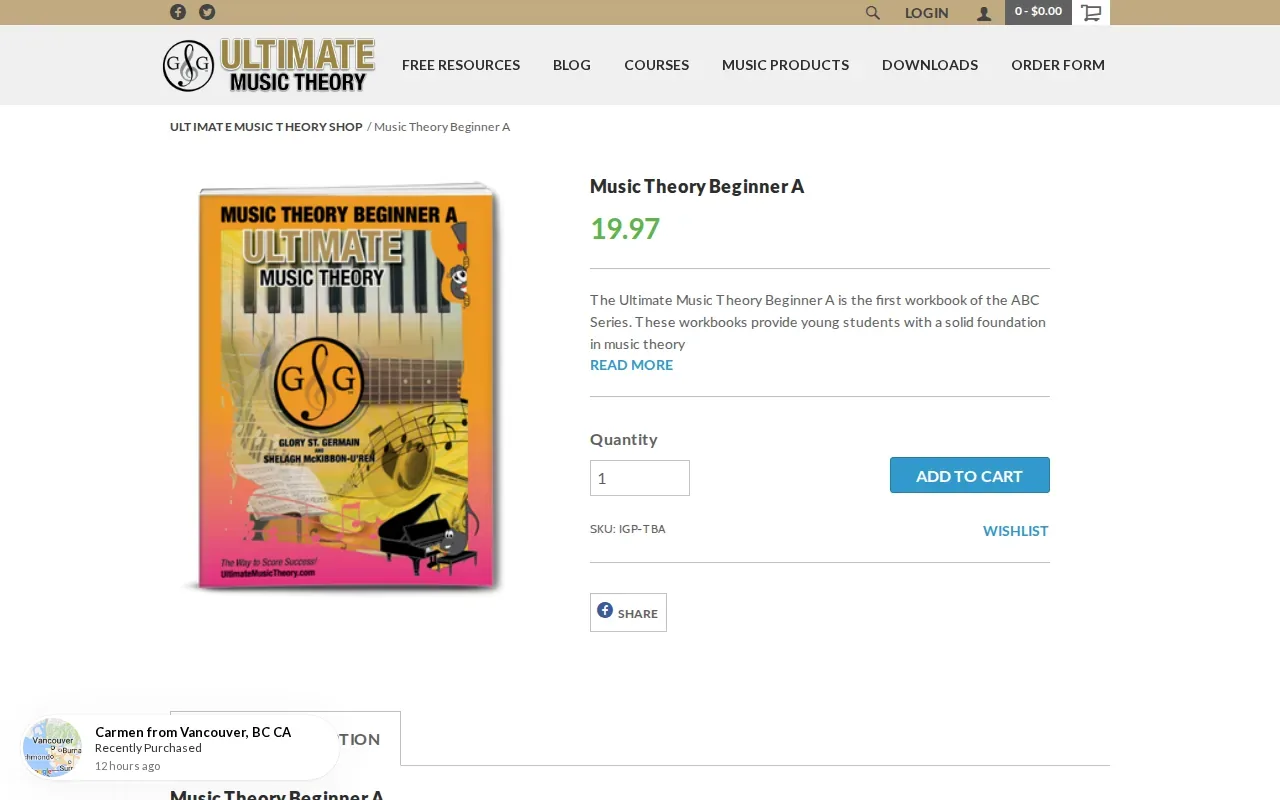
For theory study, written work can be connected with what you hear and try at an instrument. At the piano, for example, you might practise reading a notation example, then play the notes at a comfortable pace. This gives you a usable way to explore how written music relates to sound.
A teacher can set a few pages at a time, or you can choose a pace that feels manageable for independent study. If you’re learning at the piano, pause after a written task and play the notes you’ve just worked with. That short link between pencil and keyboard can make a symbol feel less abstract.
Music Theory Beginner A is aimed at a starting level. As you work through exercises, take time to check your responses and revisit any concepts that feel unfamiliar.
Pick it when you want a first-year theory path. If you already read comfortably on the grand staff, a more advanced starting point may fit better.
4. Music Theory Simplified by Musician Goods
Music Theory Simplified by Musician Goods is a full-colour book by Melvin Tellier, available as a paperback, PDF or bundle. Its focus is functional harmony for producers and songwriters, though the material is taught on the keyboard and is intended to apply across instruments.

The book uses visual explanations to connect ideas such as intervals, scales, keys and chord building. Its chapters include diagrams, a cheat sheet, a jargon guide and a QR code linking to a video tutorial. That format may suit you if you learn best when you can see a pattern on the keyboard and then watch someone explain it.
For a songwriter, the harmony focus can help turn a chord shape into a question: what notes make it up, and how does it behave in a key? For a producer, the same idea can help connect a piano-roll pattern with the sound it makes. You don’t need to approach every chapter in one sitting. Try a small example after reading and check that you can explain what changed.
This title is a fit if you want a visually led approach aimed at songwriters and producers. It also makes sense for a self-taught player who wants theory explained through the keyboard, rather than through written notation alone.
5. Music Theory in Practice, Grade 1 by ABRSM
Music Theory in Practice, Grade 1, by Eric Taylor and published by ABRSM, offers explanations, worked examples and exercises at an introductory grade level. The shop lists a printed book. Check the selected edition and delivery format before purchase.
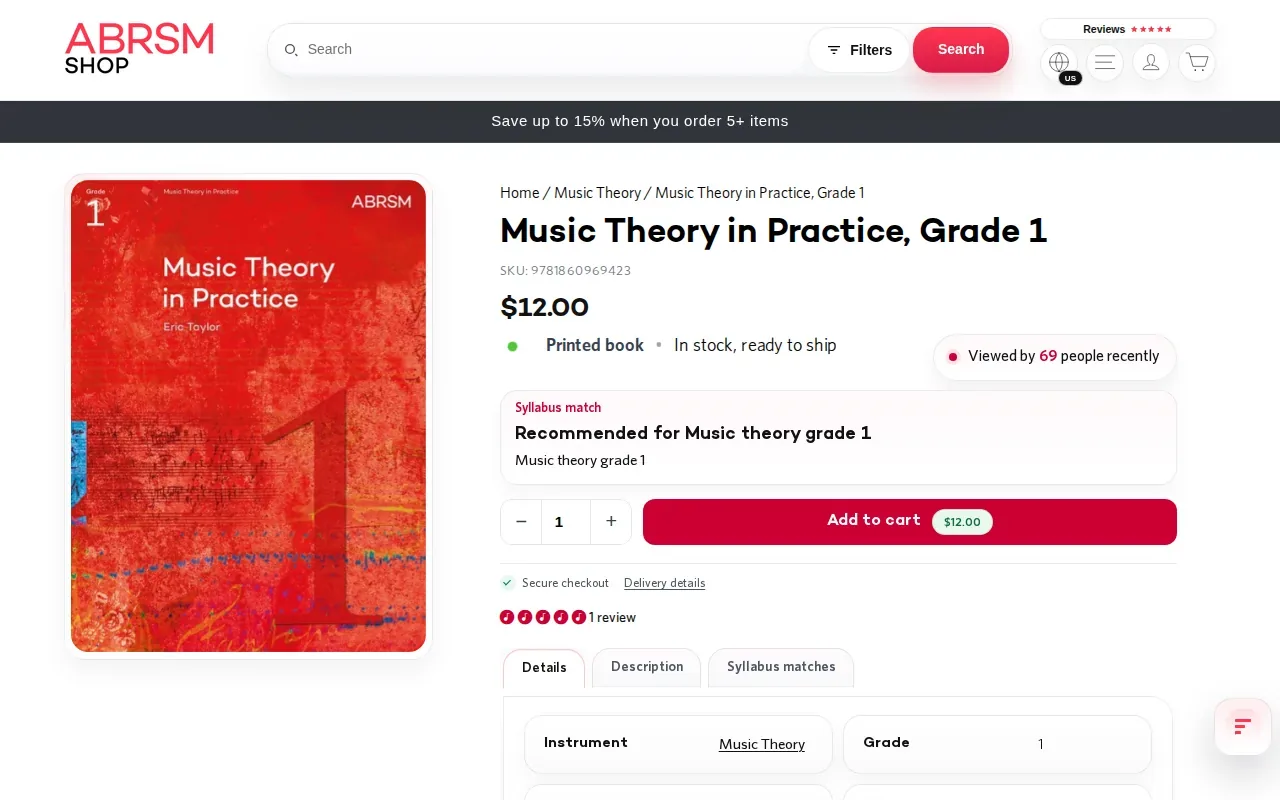
A grade-specific resource can give your practice a clear level to aim at. Before buying, check that Grade 1 matches your current study and the exam route you have in mind. If you’re learning for pleasure, the grade label can still help you judge the intended level, but it needn’t set your pace.
The Open University lesson on intervals provides a separate explanation of how distances between notes are named. When an exercise asks for an interval, count both letter names at the ends: C to E spans C, D and E, so its number is a third. Its quality also depends on the accidentals and semitone distance.
This is the most exam-directed choice in the shortlist. It may suit you when you know the grade you need and want written practice at that level. Check the current syllabus if you are preparing for an assessment; owning a book does not guarantee an exam result.
Compare the five music theory workbook options
Use the main learning goal to narrow the field. Format matters too: decide whether you’d rather write answers on a printed page, read a PDF or hear examples as you study.
| Option | Best fit | Study style |
|---|---|---|
| Chord Compass Academy | Self-directed theory and harmony learners | Downloadable PDF with explanations, exercises and answers |
| Music Theory Workbook for All Musicians by Hal Leonard | Learners seeking broad theory drills | Self-study explanations, examples and written exercises |
| Music Theory Beginner A | Beginner and first-year students | Foundational theory through a series |
| Music Theory Simplified by Musician Goods | Producers and songwriters | Visual keyboard-led study with video tutorials |
| Music Theory in Practice, Grade 1 by ABRSM | Learners working at Grade 1 | Printed workbook for grade-level study |
For more title-by-title context, see our shortlist of books for learning music theory. Then choose the option whose level and format match the way you’ll actually practise.
Before buying, try a short written task using material you already understand. Write C, E and G, then identify them as the notes of a C major triad. Play them together if you have an instrument available, then separately. Write one sentence about what stayed the same: the pitch names belong to the same triad even though you changed how you played them. If a workbook jumps straight to unfamiliar symbols, choose an earlier starting point. If every task is already easy, look for a sample chapter that asks you to apply ideas in a new key or explain your reasoning.
Frequently asked questions
Do I need to know music before using a theory workbook?
No, some workbooks are designed for beginners with little or no theory background. Music Theory Beginner A is suitable for first-year students, while Music Theory Simplified says no prior theory is needed. Check each book’s stated level and approach. If you already play, you can also start with the concept that answers a question you have about your music.
Which music theory workbook is best for piano learners?
The best fit depends on what you want to learn. Chord Compass Academy’s Music Theory, Decoded, Edition 2 pairs foundational theory with usable examples, exercises and answers. Music Theory Simplified teaches concepts visually on the keyboard and is aimed at producers and songwriters. With either approach, you can use your own instrument to connect written examples with sound.
Can I use a theory workbook without a teacher?
Yes, several options are described for self-study or independent work. Look for examples and exercises you can check, such as the written practice in Hal Leonard’s workbook or the exercises and answers in Music Theory, Decoded, Edition 2. Work in short sessions, then play or listen to the idea you’ve studied. If a concept stays foggy, ask a teacher to help you hear it.
How many pages should I study each week?
There isn’t one weekly page target that suits every learner. A page of new notation may take longer than a familiar review task, and some books include audio or video to explore alongside reading. Try one small section at a time. Move on when you can explain the idea in plain words or use it in a short musical example.
Choose a workbook that fits your next question
For a downloadable explanation of theory with exercises and answers, explore Chord Compass Academy’s Music Theory, Decoded, Edition 2. Visit the Music Theory, Decoded, Edition 2 page to explore its contents and preview two chapters.