
Learn with Chord Compass
How to Learn Piano as an Adult: 5 Steps
Learn how to learn piano as an adult with a steady routine, simple reading drills, gradual hand coordination and music that keeps you curious.
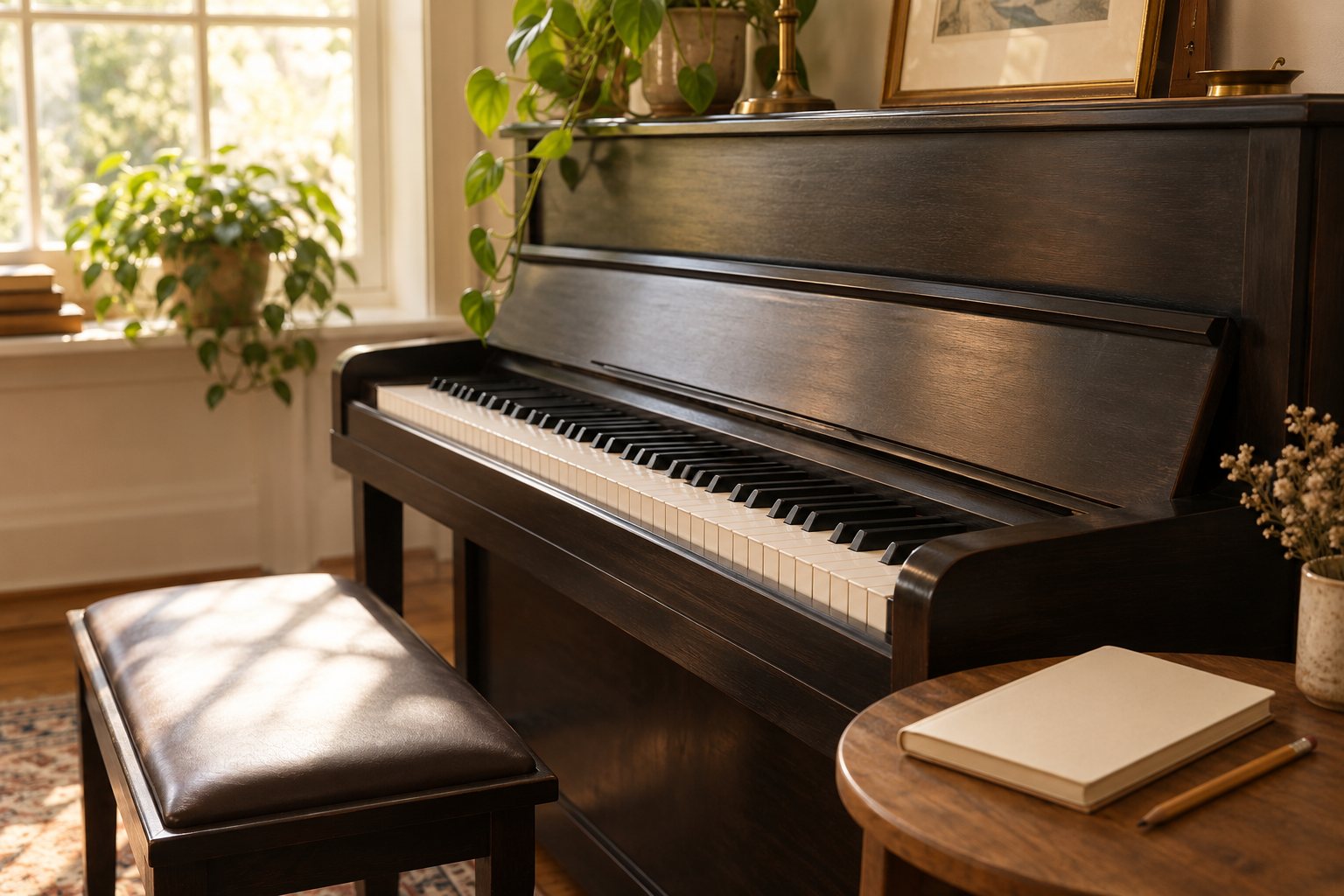
That song you picture playing isn’t out of reach because you’re an adult. How to learn piano as an adult comes down to a clear starting point and small, steady steps. You can begin with a keyboard, a practice plan and music you enjoy, then build skill one note at a time.
Step 1: Set a clear goal and a workable practice routine
Pick one goal you can hear or see. It might be playing a short tune with both hands, reading the notes around middle C, or changing between two chords without stopping. A clear goal gives each practice session a job.
Choose music that matters to you and a practice time that fits your day. Your starting experience and available time will shape your routine. There is no need to compare your pace with a child’s or another adult’s.
Start with a short block of 15 to 20 minutes on most days. Put it beside something you already do, such as your first cup of tea or the end of your workday. On a packed day, use a five-minute practice: play a familiar pattern, work one tricky bar, then stop while you still feel fresh.
Give each session a simple shape. Spend a few minutes warming up with notes or a pattern you know. Work slowly on one passage that needs attention. Finish by playing music you like, even if it’s only a few bars.
That balance matters. If you only run through the parts that already sound good, the difficult change stays difficult. If every session feels like a test, practice can lose its appeal. A useful piano practice plan helps you decide what to work on before you sit down.
Write down what you did and one thing to try next time. For example: “Played C to G with each hand. Try the left hand more slowly tomorrow.” Progress is easier to spot when you leave yourself a small note.
Step 2: Get to know the keyboard and start reading notes
Begin with the black keys. They sit in groups of two and three. The white key just to the left of a group of two is C. Move up the white keys in order: C, D, E, F, G, A, B, then C again.
Find middle C, near the centre of the keyboard, and use it as your home base. Rest your right thumb on C and place the next four fingers on D, E, F and G. For the left hand, place the little finger on a lower C, then let the other fingers rest on D, E, F and G. Play each hand separately at first. Keep your shoulders easy and let your hands rest in a natural curve.
You don’t have to memorise every key at once. Learn a small group, find those notes on the page, then play them. A piano score uses two staves joined together, often called the grand staff. The top staff usually shows higher notes; the lower staff shows lower notes. A Open University introduction to clefs can help you recognise how a clef establishes the pitches represented on a staff.
Use short drills to join the page to the keyboard. Point to a note near middle C and say its letter name. Find it on the keys. Then play a few notes in order, slowly, while saying the names aloud. Start with five notes rather than trying to read a whole page at speed.
Rhythm deserves its own turn. Clap a short pattern before playing it. Count a steady “one, two, three, four” if the piece has four beats in each bar. Then add the notes. This stops note names from crowding out the pulse.
If written music is new to you, keep the first reading task small. Learn a few notes, then add more as they appear in your pieces. Chord Compass Academy’s Reading Music, Decoded, Edition 2 is a downloadable music-reading book for learners who want a guided way to work on notation and rhythm.
Step 3: Build rhythm and hands-together coordination gradually
Two hands can feel like two conversations at once. Make each part clear on its own, then bring them together at a pace that lets you listen.
Choose a short section, perhaps one or two bars. Play the right hand alone until you can keep the notes and rhythm moving. Then work on the left hand. If one hand is much harder, give it a little more time, but don’t wait until both parts feel perfect before combining them.
Start hands together more slowly than you think you need. You might play one beat at a time, pause, then continue. If the hands lose their place, stop and find the point where they separated. Repeat that small spot rather than restarting the whole piece every time.
Try this sequence:
- Say or tap the beat before you play.
- Play the right-hand part slowly, then the left-hand part.
- Combine them at a slower pace, keeping the pulse even.
- Repeat the section cleanly before adding a little speed.
A metronome can mark a steady beat while you focus on the notes. Start at a pace where you can play without tensing up. If the click makes you rush, turn it off for a moment and count aloud, then bring it back once the rhythm settles.
Hands-apart work is a tool, not a destination. Once each part is familiar, playing together is the skill that needs practice. If the left hand keeps slipping, return to it alone for a short repair, then join the hands again.
You can also record a short passage on your phone and listen back. Notice one thing at a time: perhaps the beat wavers, or one note is quieter than you expected. You don’t need to fix everything in one session. Chord Compass Academy has separate steps for practising piano with both hands if you want more exercises for coordination.
Step 4: Use simple scales and chords to understand what you play
Scales and chords help notes make sense as a group. They also give you a way to hear why one sound feels bright, calm or a little unsettled.
Begin with the C major scale: play the white keys from C up to the next C, then come back down. Use one hand at a time and keep each note even. Don’t worry about speed. Notice how the pattern returns to C, which gives the scale a sense of arrival.
Next, try a C major chord by playing C, E and G together. Those notes make a triad: a three-note chord whose notes can be arranged in thirds. C is this triad’s root. The root is not always the first or lowest note played; an inversion puts a different chord note in the bass. A Open Music Theory explanation of triads describes how notes sound together as a harmonic unit.
Now lower E to E-flat and play C, E-flat and G. Listen to the change from major to minor. You don’t need a long theory lecture to hear the difference. Try both shapes slowly and let your ear notice what changed.

Put the chord into a short progression. Play the C major triad (C, E, G) for four slow beats, then F major (F, A, C), then G major (G, B, D), before returning to C major. If the hand has to jump far, pause between chords and find the next shape without rushing. Later, you can explore inversions, which rearrange the same notes to make chord changes smoother.
Say the chord names as you play. This links the sound to the keys under your fingers. If you hear a song move from C to G, for example, you can begin to recognise the change rather than treating each chord as a new puzzle.
Chord Compass Academy’s Root Position, Edition 2 is a 301-page downloadable piano PDF for beginner and returning learners. It includes a 12-week practice plan and 24 original studies, so you can pair foundation work with a clear sequence of pieces. Its ideas can sit beside the music you already enjoy.
Step 5: Choose suitable music and review your progress
Pick music that gives you a reason to sit down again. That might be a simple tune you know by ear, a gentle melody from a method book or an easy version of a song you love. Choose a piece that feels just beyond your current comfort, not several levels beyond it.
Build a short song list with two kinds of music. Keep one piece that helps you learn a new skill, such as a steady left-hand pattern. Add another that you play for pleasure. When the first one feels demanding, the second gives practice a softer landing.
Before you start a piece, check its length and hand movement. A short melody using a few nearby notes may suit you now. A piece with wide jumps or a fast rhythm can wait, even if you love the sound. You can still listen to it and keep it on your list for later.
Learning as an adult can mean fitting practice around work, family or other duties. Use small time blocks when a full session won’t fit. Five minutes spent naming notes or clapping a rhythm keeps the music close, even if you can’t reach the keyboard that day.
Review your progress once a week. Play a passage you worked on earlier and ask: can I keep the beat? Do I know where the hands meet? Does one change still catch me? Pick one answer and use it to shape the next week’s practice.
Record the same short passage from time to time. A recording gives you something more useful than a vague feeling that you are or aren’t improving. Compare the beat, note clarity or the number of times you stop. Small changes count.
Adults may judge early playing against the music they already love. Give yourself room to sound like a beginner while you learn. The point is not to rush through easy pieces; it’s to use them to build control, reading and confidence for the music you want to play.
If you prefer a structured downloadable path, Chord Compass Academy’s Root Position, Edition 2 can guide your piano foundation practice. It’s a one-off PDF purchase rather than a subscription, and its product page includes a preview of two chapters. The academy also has separate personalised online lessons, which are a different offer from the books.
For a focused next step, our introduction to playing chords on piano connects chord names with the notes under your fingers.
FAQs About Learning Piano as an Adult
Is it hard to learn piano as an adult?
Learning piano as an adult takes patience, but age doesn’t make it out of reach. You can use your ability to plan and your knowledge of music you enjoy. Start with a small goal, practise often and build each new skill on the last one. Your pace will depend on your schedule and the music you choose.
How often should an adult beginner practise piano?
A short session on most days is a useful starting point. Try 15 to 20 minutes when your schedule allows, with one clear task for each session. On a busy day, a five-minute note or rhythm drill can keep the habit alive. Regular focused practice is easier to sustain than waiting for a long free afternoon.
Do I need to read music to learn piano?
No, you can begin by learning notes by ear or following simple patterns, but reading music gives you another way to learn pieces on your own. Start with a few notes near middle C and learn rhythm alongside them. Add more notes gradually, so the page stays manageable while your keyboard skills grow.
What should I learn first on piano?
Start by finding notes on the keyboard and playing a simple five-note pattern with each hand. Then learn a few written notes and practise a steady beat. Add hands-together work once each part feels familiar. A short, easy piece gives those skills a musical purpose as you practise.
Can I teach myself piano as an adult?
Yes, you can learn independently with a clear sequence of tasks and regular practice. A book or course can help you know what to work on next, while a teacher can give personal feedback if you want it. If you teach yourself, check your posture and sound often, and slow down when a passage feels uncertain.
Your next practice session
Try a guided piano foundation
Choose one piece you’d like to play, set a short practice time and work on its first few notes this week. For a guided piano foundation, explore Root Position, Edition 2 from Chord Compass Academy and preview two chapters. Then let the next small discovery lead you on.